

48 amp EV chargers
The fastest output a domestic circuit realistically carries, and the point at which hardwiring stops being optional.
Every figure here is taken from the manufacturer’s published listing and measured against the rest of the group. We do not test chargers. Where a listing is silent on a specification, this site prints not stated rather than a plausible default.
What this group looks like
| Measure | Middle half | Median |
|---|---|---|
| Output | 48 – 48 A | 48 A |
| Breaker required (derived) | 60 – 60 A | 60 A |
| Cable reach | 25 – 25 ft | 25 ft |
The middle-half column spans the 25th to 75th percentile, so it describes where most of this group sits rather than being pulled about by one unusual unit.
This is arithmetic, not a design. The breaker figures here are the manufacturer’s published output multiplied by 1.25 and rounded up to the next standard size, which is what the continuous-load rule requires. They tell you what to expect before you call an electrician; they are not a substitute for one, and they say nothing about whether your panel has the capacity, what wire the run needs, or what your local code requires.
Against the market as a whole this group reaches about as far as average — a median cable of 25 ft against 25 ft overall. Cable length is the specification owners most often say they would change.
What these listings publish
Specification coverage is uneven, and knowing where it runs out is part of shopping honestly. A missing figure does not mean a worse charger — it means a less completely described one.
| Specification | Stated | Share |
|---|---|---|
| Output amperage | 17 | 100% |
| Voltage | 14 | 82% |
| Power in kW | 7 | 41% |
| Cable length | 11 | 65% |
| Connector type | 16 | 94% |
What they cost
Bands, not prices — and the charger is only part of the bill. A new circuit is frequently the larger half, and no listing prices it.
| Band | Listings | Share |
|---|---|---|
| $200–350 | 2 | 12% |
| $350–500 | 10 | 59% |
| $500–800 | 5 | 29% |
48, not 50, and that is deliberate
A 48 A charger needs a 60 A breaker — exactly, with nothing wasted, because 48 divided by 0.8 is 60. A 50 A charger needs 70 A, since 62.5 is not a breaker that exists. Manufacturers settled on 48 because it is the largest output that lands squarely on a standard breaker, and because 60 A is about as much as an ordinary domestic panel will spare.
You will be hardwiring it
There is no domestic receptacle designed to carry 48 A continuously for eight hours, so chargers at this output are wired directly to the panel. That is not a drawback in itself — it is tidier and has fewer failure points — but it does mean the charger cannot come with you when you move, and an electrician is not optional.
Check the panel before the charger
A 60 A circuit is a substantial share of a domestic service. Whether your panel can carry it alongside everything else is a load calculation, and in an older house the answer is sometimes no. That question decides this purchase far more often than anything on the listing does.
Where hardwiring becomes compulsory
At this output the circuit needed is beyond what any domestic receptacle is rated to carry continuously, so these are hardwired almost without exception. That removes the plug as a failure point and removes the option of taking the charger when you move. The step up from the band below is roughly ten minutes on a typical overnight charge, and the step up in installation cost is considerably larger than that suggests.
The breaker is not the charger’s amperage
An EVSE is a continuous load, so the circuit must be rated at least 125 per cent of the charger’s output. Across this corpus the median charger draws 40 A and needs a 50 A circuit, and the relationship holds at every step of the range. Buyers who size the circuit from the headline figure discover the difference when the electrician quotes, and there is no breaker made at some of the amperages people expect to buy.
Cable length is the specification owners regret
Nearly every charger in this corpus that states a cable length states the same one, so the figure barely differentiates products — and it is the specification owners most often say they would change. Measure from where the unit will actually be mounted to the furthest charge-port position you expect to use, including the car parked the other way round and a second vehicle. A charger that reaches is worth more than one that charges marginally faster, and the reach cannot be added later.
Mounting, and the wall it goes on
Weight is stated on roughly half these listings, and where it is given these units are heavy enough that the fixing matters: a charger on plasterboard with no timber behind it will eventually pull out, taking the cable with it. Most manufacturers supply a bracket and expect it to reach something structural. Outdoors the same fixing has to survive weather for a decade, which is a different problem from holding the weight on day one.
Before you buy
Ask what the panel can spare before choosing an output
A charger’s amperage decides the circuit, and the circuit decides whether the job is an afternoon or a service upgrade. In an older house the panel is frequently the real constraint, and finding that out before choosing a charger saves returning one.
Measure the cable run properly
Measure from where the charger will actually be mounted to the furthest charge-port position you expect to use — the car parked the other way round, and a second vehicle. Twenty-five feet is common and is not generous once the cable goes around a car rather than straight at it.
Treat marketing language as a claim, not a specification
Where a phrase on a listing matters to your decision, look for the number behind it: a stated output in amps rather than a sentence about fast charging, a stated cable length rather than a description of reach. Where this site could not find that number, it says not stated.
Compare them
The finder below is already filtered to this group. Widen or narrow it from there — every result shows the breaker it needs and is measured against the median for its own output class.
17 chargers match

EMPORIA Level 2 EV Charger w/NACS, Compatible with Tesla – 48 amp Electric Car Charger, Preconfigured for Hardwired Install with Whip, UL/Energy Star WiFi-Enabled EVSE, 24ft Cable, White
- Breaker needed
- 60A
- Power
- 11.5kW
- Voltage
- 240V
- Cable
- 24ft
- W x D x H
- not stated
- Weight
- not stated
Charger output
48A
Hardwired · 41 to 48 A charger · 17 chargers
Cable reach
24ft of cable
-4% vs the 25 median — typical for its class
Output is 0% against the class median of 48.

WOLFBOX Level 2 EV Charger 48amp,Hardwired with J1772 Connector,240V(E48)
- Breaker needed
- 60A
- Power
- not stated
- Voltage
- 240V
- Cable
- 25ft
- W x D x H
- not stated
- Weight
- 13lb
Charger output
48A
Hardwired · 41 to 48 A charger · 17 chargers
Cable reach
25ft of cable
0% vs the 25 median — typical for its class
Output is 0% against the class median of 48.
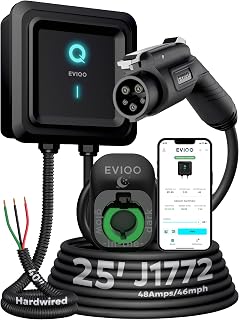
EVIQO Level 2 EV Charger J1772 48A – Hardwired 240V Wall Charging Station
- Breaker needed
- 60A
- Power
- not stated
- Voltage
- 240V
- Cable
- 25ft
- W x D x H
- 9×4×9in
- Weight
- 20lb
Charger output
48A
Hardwired · 41 to 48 A charger · 17 chargers
Cable reach
25ft of cable
0% vs the 25 median — typical for its class
Output is 0% against the class median of 48.

Level 2 EV Charger, 48Amp/11.5KW/240V, UL 2594, ETL & Energy Star
- Breaker needed
- 60A
- Power
- 11.5kW
- Voltage
- 240V
- Cable
- 25ft
- W x D x H
- 9×10×4in
- Weight
- 13lb
Charger output
48A
All · 41 to 48 A charger · 17 chargers
Cable reach
25ft of cable
0% vs the 25 median — typical for its class
Output is 0% against the class median of 48.

EMPORIA Level 2 EV Charger w/ J1772 Connector — 48 Amp, 240V WiFi Enabled Electric Vehicle Charging Station, 25ft Cable, NEMA 14-50, White
- Breaker needed
- 60A
- Power
- not stated
- Voltage
- 240V
- Cable
- 25ft
- W x D x H
- 9×3×13in
- Weight
- 17lb
Charger output
48A
Plug-in · 41 to 48 A charger · 17 chargers
Cable reach
25ft of cable
0% vs the 25 median — typical for its class
Output is 0% against the class median of 48.

EMPORIA Level 2 EV Charger – NEMA 14-50 EVSE w/NACS, Compatible with Tesla – 48 amp EV Charger Level 2, 240v Electric Vehicle Charging Station, UL/Energy Star, 25ft Cable, White
- Breaker needed
- 60A
- Power
- 11.5kW
- Voltage
- 240V
- Cable
- 25ft
- W x D x H
- not stated
- Weight
- not stated
Charger output
48A
Plug-in · 41 to 48 A charger · 17 chargers
Cable reach
25ft of cable
0% vs the 25 median — typical for its class
Output is 0% against the class median of 48.

EVIQO Level 2 EV Charger NACS 48A – Hardwired 240V Wall Charging Station
- Breaker needed
- 60A
- Power
- not stated
- Voltage
- 240V
- Cable
- 25ft
- W x D x H
- 9×4×9in
- Weight
- 19lb
Charger output
48A
Hardwired · 41 to 48 A charger · 17 chargers
Cable reach
25ft of cable
0% vs the 25 median — typical for its class
Output is 0% against the class median of 48.

Level 2 EV Charger for Tesla, 48Amp/11.5KW, UL 2594/ETL/Energy Star
- Breaker needed
- 60A
- Power
- 11.5kW
- Voltage
- not stated
- Cable
- 25ft
- W x D x H
- 9×10×4in
- Weight
- 13lb
Charger output
48A
All · 41 to 48 A charger · 17 chargers
Cable reach
25ft of cable
0% vs the 25 median — typical for its class
Output is 0% against the class median of 48.

Lectron J1772 Level 2 EV Charger, UL2594 Certified (ETL Listed), 48A 240V Nexus EV Charging Station, 23ft Cable & J1772 Charger Holder, Hardwired ONLY, Compatible with All J1772 Electric Vehicles
- Breaker needed
- 60A
- Power
- 11.5kW
- Voltage
- 240V
- Cable
- 23ft
- W x D x H
- not stated
- Weight
- 20lb
Charger output
48A
Hardwired · 41 to 48 A charger · 17 chargers
Cable reach
23ft of cable
-8% vs the 25 median — typical for its class
Output is 0% against the class median of 48.

Tesla Wall Connector – Electric Vehicle (EV) Charger – Level 2 – up to 48A with 24' Cable
- Breaker needed
- 60A
- Power
- 11.5kW
- Voltage
- not stated
- Cable
- not stated
- W x D x H
- 6×4×14in
- Weight
- 11lb
Charger output
48A
Hardwired · 41 to 48 A charger · 17 chargers
Cable reach
Cable length not stated, so reach cannot be compared.
Output is 0% against the class median of 48.

EMPORIA Level 2 EV Charger w/ J1772 Connector — 48 Amp, 240V WiFi Enabled Electric Vehicle Charging Station, 25ft Cable, Hardwired with Whip, White
- Breaker needed
- 60A
- Power
- not stated
- Voltage
- 240V
- Cable
- 25ft
- W x D x H
- not stated
- Weight
- not stated
Charger output
48A
Hardwired · 41 to 48 A charger · 17 chargers
Cable reach
25ft of cable
0% vs the 25 median — typical for its class
Output is 0% against the class median of 48.

Wallbox Pulsar Plus Level 2 Ev Charger 48A, Electric Car Charger EVSE J1772
- Breaker needed
- 60A
- Power
- not stated
- Voltage
- 240V
- Cable
- not stated
- W x D x H
- 8×4×8in
- Weight
- 15lb
Charger output
48A
Plug-in · 41 to 48 A charger · 17 chargers
Cable reach
Cable length not stated, so reach cannot be compared.
Output is 0% against the class median of 48.
Related
- The full EV charger finder — unfiltered, every install method.
- What size breaker does an EV charger need? — the full table.
- How we compile these figures.