
Lectron Level 1 J1772 Charger (WiFi Version) – 120V: specifications and the circuit it needs
A 15 A portable charger, measured against the 25 portable chargers in this corpus — including the branch circuit it requires, which the listing does not state.

Every figure below is read from the manufacturer’s own listing. We do not test chargers and we are not electricians. Where the listing is silent, this page prints not stated rather than a plausible default, and the one number here that no manufacturer publishes — the circuit — is arithmetic on the output rating, shown with its working.
At a glance
| Specification | Stated |
|---|---|
| Output | 15 A |
| Circuit required (derived) | 20 A breaker |
| Power | 1.6 kW |
| Voltage | 120 V |
| Connector | J1772 |
| Cable reach | 16 ft |
| Install method | portable |
| Price band | Under $200 |
| App control | stated on the listing |
| Brand | Lectron |
The circuit this one needs
An EV charger is a continuous load, so the branch circuit must be rated at least 125 per cent of its output. At 15 A that is 18.8 A, and the smallest breaker actually manufactured at or above that figure is 20 A. That is the number to give an electrician, and it is the number that decides what the installation costs — frequently more than the charger.
This is arithmetic, not a design. The breaker figures here are the manufacturer’s published output multiplied by 1.25 and rounded up to the next standard size, which is what the continuous-load rule requires. They tell you what to expect before you call an electrician; they are not a substitute for one, and they say nothing about whether your panel has the capacity, what wire the run needs, or what your local code requires.
How it compares with its own class
Against the 25 portable chargers in this corpus, rather than against a generic alternative:
| Measure | This one | Class median | Where it sits |
|---|---|---|---|
| Output | 15 A | 16 A | below the class median of 16 A |
| Breaker required (derived) | 20 A | 20 A | the same as the class median |
| Power | 1.6 kW | 3.8 kW | below the class median of 3.8 kW |
| Cable reach | 16 ft | 25 ft | below the class median of 25 ft |
A charger sitting on the class median is not a worse buy than one above it. The figure that matters is whether the output suits the panel and the car, and a unit above the median on output is also above it on what the circuit will cost.
Where it suits
- A panel that can spare a 20 A branch circuit, confirmed by a load calculation rather than assumed.
- Charging in more than one place, or as a second charger kept in the car.
- A plug-in hybrid, a short commute, or an overnight top-up rather than a full refill.
- Charging on an off-peak tariff, where scheduling is worth real money.
Where it does not
- A household wanting a fixed, tidy installation that lives on the wall permanently.
- A large battery charged from low overnight, which this will not refill in the time available.
- A circuit smaller than the charger requires, since the output here is not adjustable.
- A driver unwilling to use an adapter, if the car does not take J1772 directly.
What the listing claims
These are the manufacturer’s statements, not findings. Nothing on this page has been measured by anyone here, and a specification stated on a listing is a claim until the unit is in front of you.
It states output, circuit required, power, voltage, connector, cable reach. It does not state whether the output can be adjusted.
The gaps matter as much as the figures. A listing that omits a cable length is not describing a short cable, it is describing itself incompletely — and cable reach is the specification owners most often say they would change, because it cannot be added afterwards.
What no listing on this site tells you
Three things decide whether an installation is a good one, and none of them is a specification any manufacturer publishes. The first is what the panel can spare, which is a property of your house rather than of the charger — a 20 A circuit is either available or it is the start of a much larger job, and only a load calculation says which. The second is the run itself: the distance from the panel to where the charger will hang, whether it is a straight route or through a finished wall, and what that length of cable at that gauge costs. On a long run the wire is frequently the single largest line on the quote, and it scales with the amperage the circuit is built for.
The third is siting, which is decided once and lived with. Which side the charge port is on, whether the car ever reverses in, whether a second vehicle will share the charger, and whether the cable will be walked over every day. None of that appears on a listing and all of it determines whether the cable reaches. This one states 16 ft, and a cable measured around a car rather than straight at it is shorter than it sounds.
Worth checking in the manual rather than the listing: whether the unit is rated for outdoor mounting where you intend to put it, what the warranty actually covers and for how long, and — if it offers scheduling — whether the schedule lives on the device or in an account with a company that may not be selling chargers in ten years. A charger is a fifteen-year fixture. The app is not.
Before you decide
Confirm the panel before the charger
A 20 A circuit has to come from somewhere. In an older house the spare capacity is frequently the real constraint, and a load calculation costs nothing next to returning a charger that could never have been installed.
Measure the run the car actually needs
Measure from where the unit will be mounted to the furthest charge-port position you expect to use — the car parked the other way round, and a second vehicle. 16 ft is less generous once it goes around a car rather than straight at it.
Treat marketing language as a claim
Where a phrase on the listing matters to your decision, look for the number behind it: a stated output in amps rather than a sentence about fast charging. Where this site could not find that number, it says not stated.
If the circuit works and the reach is right, the current price and availability are on Amazon — this site deliberately does not quote either, because both are stale within days of being read.
Check current price and availability
Compare it against the rest of its class
The finder below is filtered to portable chargers. Every result shows the breaker it needs and is measured against the median for its own class.
29 chargers match

Lectron Level 1 EV Charger – ETL Certified, 110V, 15 Amp, 16 ft Extension Cord & J1772 Cable – Portable Electric Car Charger for J1772 EVs with NEMA 5-15 Plug
- Breaker needed
- 20A
- Power
- 1.6kW
- Voltage
- 120V
- Cable
- 16ft
- W x D x H
- 4×15×11in
- Weight
- 6lb
Charger output
15A
Portable · up to 16 A charger · 16 chargers
Cable reach
16ft of cable
-36% vs the 25 median — shorter than most in its class
Output is -6% against the class median of 16.

Level 2 EV Charger, 48Amp/11.5KW/240V, UL 2594, ETL & Energy Star
- Breaker needed
- 60A
- Power
- 11.5kW
- Voltage
- 240V
- Cable
- 25ft
- W x D x H
- 9×10×4in
- Weight
- 13lb
Charger output
48A
All · 41 to 48 A charger · 17 chargers
Cable reach
25ft of cable
0% vs the 25 median — typical for its class
Output is 0% against the class median of 48.
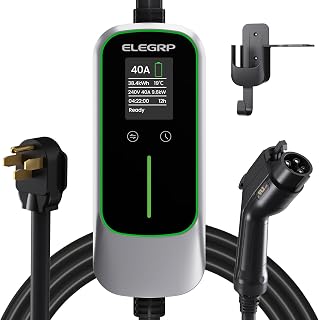
ELEGRP Level 2 EV Charger 40Amp, J1772 Portable Electric Car Charger, 240V NEMA 14-50 Plug, ETL Certified with 25FT Extension Cable
- Breaker needed
- 50A
- Power
- 9.6kW
- Voltage
- 240V
- Cable
- 25ft
- W x D x H
- 134×144×47in
- Weight
- 13lb
Charger output
40A
Portable · 33 to 40 A charger · 18 chargers
Cable reach
25ft of cable
0% vs the 25 median — typical for its class
Output is 0% against the class median of 40.

EVDANCE Level 2 EV Charger 40Amp, 240V 9.6KW Portable Electric Vehicle Charging Stations with NEMA 14-50P, 25FT Cable Adjustable Current/Timing Delay Home Electric Car Charger for J1772 BEVs/PHEVs
- Breaker needed
- 50A
- Power
- 9.6kW
- Voltage
- 240V
- Cable
- 25ft
- W x D x H
- not stated
- Weight
- 12lb
Charger output
40A
Portable · 33 to 40 A charger · 18 chargers
Cable reach
25ft of cable
0% vs the 25 median — typical for its class
Output is 0% against the class median of 40.

Level 2 EV Charger for Tesla, 40Amp/9.6KW, UL 2594/ETL/Energy Star
- Breaker needed
- 50A
- Power
- 9.6kW
- Voltage
- 240V
- Cable
- 25ft
- W x D x H
- 9×10×4in
- Weight
- 13lb
Charger output
40A
All · 33 to 40 A charger · 18 chargers
Cable reach
25ft of cable
0% vs the 25 median — typical for its class
Output is 0% against the class median of 40.

Level 2 EV Charger 32 Amp Portable J1772 NEMA 14-50 7.6kW 25ft Cable
- Breaker needed
- 40A
- Power
- 7.6kW
- Voltage
- 240V
- Cable
- 25ft
- W x D x H
- not stated
- Weight
- not stated
Charger output
32A
Portable · 17 to 32 A charger · 9 chargers
Cable reach
25ft of cable
0% vs the 25 median — typical for its class
Output is 0% against the class median of 32.

EVDANCE Level 1&2 EV Charger, Electric Vehicle Portable Charger with 25FT Cable, ETL Listed J1772 EVSE for All EVs & PHEVs, 12A 120V/16A 240V(Black, 16A Max | NEMA 5-15&6-20(Standard Home Plug))
- Breaker needed
- 20A
- Power
- 3.8kW
- Voltage
- 120V
- Cable
- 25ft
- W x D x H
- 4×8×25in
- Weight
- 7lb
Charger output
16A
Portable · up to 16 A charger · 16 chargers
Cable reach
25ft of cable
0% vs the 25 median — typical for its class
Output is 0% against the class median of 16.

VEVOR Level 1+2 Portable EV Charger, 16 Amp 120V or 240V, Electric Vehicle Charger with 28-Foot Charging Cable NEMA 6-20P Plug NEMA 5-15 Adapter, Plug-in Home EV Charging Station for SAE J1772 EVs
- Breaker needed
- 20A
- Power
- 3.8kW
- Voltage
- 120V
- Cable
- 28ft
- W x D x H
- not stated
- Weight
- 7lb
Charger output
16A
Portable · up to 16 A charger · 16 chargers
Cable reach
28ft of cable
+12% vs the 25 median — more reach than most in its class
Output is 0% against the class median of 16.

Level 1&2 EV Charger, Electric Vehicle Portable Charger with 20FT Cable, 3.5KW 16Amp Home EV Car Charging Station, 110V-240V NEMA 6-20 & NEMA 5-15 Plug Adapter, for All SAE J1772
- Breaker needed
- 20A
- Power
- 3.5kW
- Voltage
- 240V
- Cable
- 20ft
- W x D x H
- 4×240×2in
- Weight
- 6lb
Charger output
16A
Portable · up to 16 A charger · 16 chargers
Cable reach
20ft of cable
-20% vs the 25 median — shorter than most in its class
Output is 0% against the class median of 16.

Level 1&2 EV Charger,12/16 Amp 6-20P/5-15 Adapter,25ft for J1772 EVs
- Breaker needed
- 20A
- Power
- 3.7kW
- Voltage
- 240V
- Cable
- 25ft
- W x D x H
- 3×2×9in
- Weight
- 8lb
Charger output
16A
Portable · up to 16 A charger · 16 chargers
Cable reach
25ft of cable
0% vs the 25 median — typical for its class
Output is 0% against the class median of 16.

Level 2 EV Charger for Tesla, 48Amp/11.5KW, UL 2594/ETL/Energy Star
- Breaker needed
- 60A
- Power
- 11.5kW
- Voltage
- not stated
- Cable
- 25ft
- W x D x H
- 9×10×4in
- Weight
- 13lb
Charger output
48A
All · 41 to 48 A charger · 17 chargers
Cable reach
25ft of cable
0% vs the 25 median — typical for its class
Output is 0% against the class median of 48.
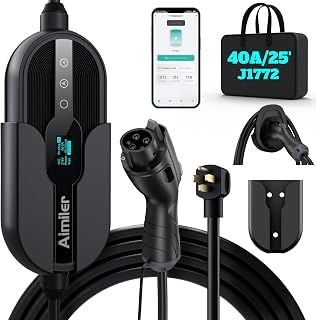
AIMILER Level 2 Electric Vehicle (EV) Charger(WiFi APP/Plug-Play), 40A, 25ft Cable ETL Certified, 220V-240V NEMA 14-50P Plug EVSE w/ J1772 Connector, Portable EV Car Charging Stations (Jet)
- Breaker needed
- 50A
- Power
- 9.6kW
- Voltage
- 240V
- Cable
- 25ft
- W x D x H
- not stated
- Weight
- not stated
Charger output
40A
Portable · 33 to 40 A charger · 18 chargers
Cable reach
25ft of cable
0% vs the 25 median — typical for its class
Output is 0% against the class median of 40.
Related
- Portable EV Chargers — the full class, with baselines for every specification.
- What size breaker does an EV charger need? — the full table.
- The full EV charger finder — unfiltered, every install method.
- How we compile these figures.